On July 3, the Catholic Church celebrates the Feast of Saint Thomas the Apostle. Revered historically as the one who touched the wounds of the Risen Lord, his journey takes us from the doubts of the Upper Room to the distant coasts of India, and finally to the quiet resting place of his relics in Ortona, Italy.
Who Was Saint Thomas the Apostle?
Saint Thomas, also known as Didymus (meaning “the twin”), was one of the Twelve Apostles chosen by Jesus Christ. Beyond his famous hesitation to believe in the Resurrection, he was a courageous disciple who once declared himself ready to go to Judea to die with Jesus, later becoming one of the most far-reaching missionaries of the early Church.
The Gospels portray Thomas as a man of frank honesty and deep attachment to his Master. When Christ announced His return to Judea—a region where people had recently tried to stone Him—it was Thomas who urged the other disciples: “Let us also go, that we may die with him” (Jn 11:16). During the Last Supper, he did not hesitate to reveal his lack of understanding, asking: “Lord, we do not know where you are going; how can we know the way?” (Jn 14:5), which prompted Jesus’ profound self-revelation: “I am the way, and the truth, and the life.”
Why Did Saint Thomas Doubt the Resurrection?
Thomas’ doubt was not an act of hard-hearted rebellion, but a human struggle to comprehend the supernatural reality of the Resurrection. God allowed this moment of uncertainty so that by touching the physical wounds of Christ, Thomas’ subsequent confession of faith would serve as an unshakeable foundation for the entire Church.
According to the Gospel of John (Jn 20:24-29), Thomas was absent when the risen Savior first appeared to the disciples. Hearing their testimonies, he famously insisted: “Unless I see in his hands the print of the nails, and place my finger in the mark of the nails, and place my hand in his side, I will not believe.”
Eight days later, Jesus returned, stood among them, and invited Thomas to touch His wounds. In his General Audience on September 27, 2006, Pope Benedict XVI noted that this event is highly comforting to modern believers. He explained that Thomas’ hesitation shows us that “every doubt can lead to a bright outcome beyond all uncertainty,” transforming our human weakness into an encounter with the divine. Upon touching the wounds, Thomas uttered the most profound Christological declaration in the New Testament: “My Lord and my God” (Dominus meus et Deus meus).
Where Did Saint Thomas Preach and How Did He Die?
Saint Thomas carried the Gospel to the East, arriving in Kerala, India, in 52 AD, where he established the ancient Saint Thomas Christian community, known locally as the Nasranis. He preached to both Jewish and local Indian communities, established several churches, and was martyred by a spear near Chennai in 72 AD.
According to ancient traditions, including the Acts of Thomas, the Apostle sailed across the Arabian Sea, landing at the port of Muziris (near modern Kodungallur, Kerala) in the year 52 AD. The local Christians he established are known as Nasranis (Nazarenes) or Syrian Malabar Christians. They have preserved a distinct Eastern Christian identity and liturgy for two millennia.
Thomas traveled extensively along the Malabar and Coromandel coasts. His missionary zeal eventually led him to the eastern coast of India, where his preaching clashed with local religious authorities. He was martyred around 72 AD at St. Thomas Mount near Chennai, pierced by a lance—an instrument of martyrdom that became his primary symbol in Christian art. Today, the Santhome Cathedral Basilica in Chennai stands over his tomb.
Where Are the Relics of Saint Thomas Located?
While the tomb of Saint Thomas remains in Chennai, India, the majority of his sacred relics are venerated today in the Cathedral Basilica of Saint Thomas the Apostle in Ortona, Italy. They were brought there in 1258 by Ortonese sailors who rescued them from the Greek island of Chios.
In the third century, a significant portion of the Apostle’s relics was moved from Mylapore (India) to Edessa, an ancient center of Syriac Christianity. During the Crusades, the relics were transferred to the island of Chios in the Aegean Sea to protect them from conflict.
On September 6, 1258, an Ortonese fleet led by Leone Acciaiuoli arrived in Ortona with the relics, which were placed in the cathedral. In 1984, a scientific examination of the bones confirmed they belonged to a man from the Middle East living in the first century, consistent with the historical identity of the Apostle. Every year, the people of Ortona celebrate the feast of Il Perdono (The Pardon) on the first Sunday of May to commemorate this translation.
The Liturgy of the Feast: The Introit Mihi autem nimis
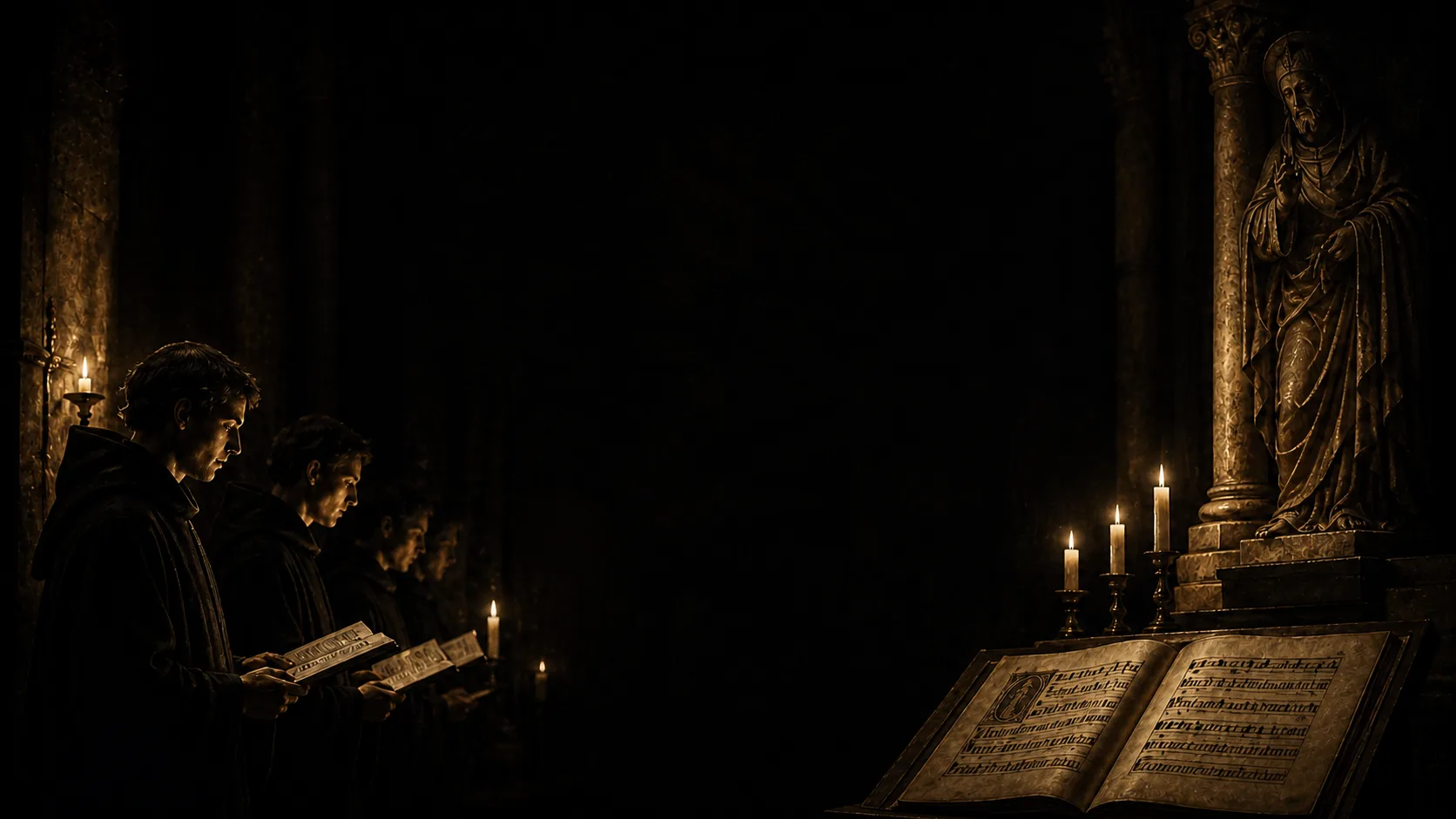
The traditional Roman liturgy honors Saint Thomas and the Apostles through the Introit Mihi autem nimis, a composition based on Psalm 138. This Gregorian chant emphasizes the great dignity and authority given to the Apostles, who were chosen as the intimate friends of God to establish His Church.
The text of the Introit reflects the Church’s reverence for those who laid the foundations of the faith:
Mihi autem nimis honorati sunt amici tui, Deus: nimis confortatus est principatus eorum.
(To me, O God, Your friends are greatly honored: their authority has been greatly strengthened.)
Musically, this chant is composed in Mode II (Plagal Protus), which is characterized by a grave, contemplative, and interior melody. It does not focus on the noise of the world, but invites the soul into the silent chamber of the heart, mimicking the silence of the Upper Room where Thomas stood before the open side of Christ.
Meditative Video and Gregorian Chant
To help you enter into the mystery of Saint Thomas’ confession, we invite you to watch this contemplative video. It features the traditional Gregorian chant Mihi autem nimis, alongside the dramatic dialogue of the Gospel translation.
Watch the Gregorian Chant meditation for Saint Thomas on YouTube
Liturgical Lyrics & Script Translation
| Section / Time | Latin / Original Text | English Translation |
|---|---|---|
| 0:00:09 | Kyrie, eleison. | Lord, have mercy. |
| 0:00:13 | Mihi autem nimis honorati sunt amici tui, Deus. | To me, O God, your friends are greatly honored. |
| 0:00:33 | Nimis confortatus est principatus eorum. | Their authority has been greatly strengthened. |
| 0:00:40 | In omnem terram exivit sonus eorum: et in fines orbis terrae verba eorum. | Into all the earth their sound has gone forth. And to the ends of the world their words. |
| 0:01:00 | In cenaculo clauso discipuli erant congregati. Et Thomas non erat cum eis. | In the closed room the disciples were gathered. And Thomas was not with them. |
| 0:01:11 | Dixerunt ei discipuli: Vidimus Dominum. | The disciples said to him: We have seen the Lord. |
| 0:01:33 | Nisi videro in manibus eius fixuram clavorum… non credam. | Unless I see the marks of the nails… I will not believe. |
| 0:01:50 | Mitte manum tuam: et cognosce loca clavorum. Noli esse incredulus, sed fidelis. | Put forth your hand: and recognize the places of the nails. Do not be unbelieving, but faithful. |
| 0:02:29 | Vide manus meas. Vide latus meum. Pax vobis. | See my hands. See my side. Peace be with you. |
| 0:02:43 | Dominus meus et Deus meus. (Malayalam: Ente Karthave, Ente Daivame) | My Lord and my God. |
| 0:03:06 | Adoro te, Christe, in vulneribus tuis. Credo, Domine; adiuva incredulitatem meam. | I adore You, O Christ, in Your wounds. I believe, Lord; help my unbelief. |
| 0:03:37 | Quia vidisti me, Thoma, credidisti: beati qui non viderunt, et crediderunt. | Because you have seen Me, Thomas, you have believed: blessed are those who have not seen and have believed. |
| 0:04:24 | Super fundamentum apostolorum et prophetarum, ipso summo lapide angulari Christo Iesu. | Upon the foundation of the apostles and prophets, with Christ Jesus Himself as the chief cornerstone. |
| 0:04:41 | In quo omnis aedificatio crescit in templum sanctum in Domino. | In Him the whole building grows into a holy temple in the Lord. |
Join the Contemplative Journey
If this meditation has brought peace to your heart, consider downloading our complete digital guidebooks and novenas. These resources are designed to deepen your daily prayer life through the traditional treasures of the Church.
Join Our YouTube Community
Subscribe to our channel to listen to complete Gregorian chants, traditional prayers, and sung meditations.
Subscribe on YouTube 🔔