
In a world filled with constant noise and visual saturation, the human soul longs for a sanctuary of peace. Gregorian chant stands as a timeless bridge to that interior stillness, offering a sacred space where the mind can rest and the heart can pray without distraction.
What is Gregorian Chant?
Gregorian chant is the traditional, monophonic, and unaccompanied sacred music of the Roman Catholic Church. Written in ecclesiastical Latin, it is not merely music added to the liturgy, but the very liturgy itself sung in a style that fosters contemplation.
Unlike secular music designed to entertain or provoke emotional excitement, Gregorian chant is inherently prayer. It is characterized by its clean, single-line melody (monophony) sung without any instrumental accompaniment (a cappella). The rhythm is free and flexible, flowing naturally from the text and pronunciation of the Latin words rather than being bound to a strict meter.
Why is it Called “Gregorian” Chant?
A common question in church history is whether Pope St. Gregory the Great (540–604 AD) invented this sacred music.
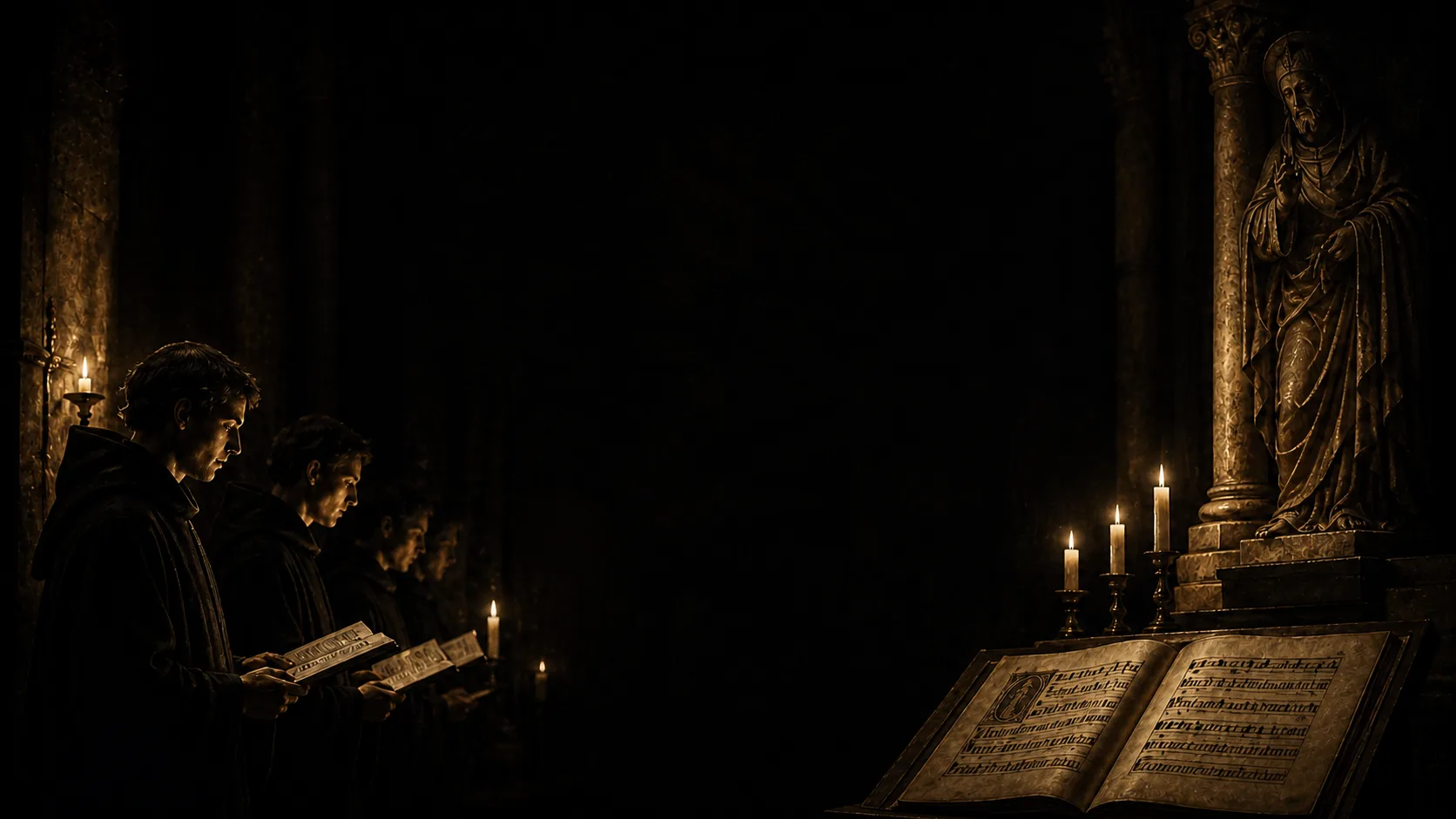
While legend depicts Saint Gregory dictating the chants under the inspiration of the Holy Spirit (often represented as a dove whispering in his ear), historical evidence suggests a more collaborative process. Pope Gregory did not compose the entire repertoire; rather, he was instrumental in codifying, organizing, and unifying the existing liturgical melodies of the Roman Rite. Under his leadership, the Church established a cohesive liturgical tradition that spread throughout Europe, establishing a unified voice for Christian worship.
The Core Characteristics of Sacred Chant
To understand the beauty of this musical tradition, we must look at its defining elements:
- Monophony: There are no harmonies, chords, or multiple parts. A single melodic line is sung by all voices in perfect unison, symbolizing the unity of the Church.
- The Unaccompanied Voice: No organ, no piano, and no percussion. The human voice—the first instrument created by God—stands alone in its purity.
- Free Rhythm: Gregorian chant does not have a time signature. Its rhythm is organic and speech-like, following the natural accents, length, and meaning of the Latin text.
- Gregorian Modes: Instead of modern major and minor scales, it relies on a system of eight tones or Gregorian modes that grant each melody a distinct spiritual atmosphere.
- Ecclesiastical Latin: Latin is not used to hide the meaning, but to elevate it. As a sacred language free from the casual nature of daily speech, it draws the soul into a transcendent realm.
- Neumatic Notation: Gregorian chant is written on a four-line staff using square-shaped notes called neumes. You can dive deeper into this system in our article on neumes and medieval music notation.
The Supreme Model of Liturgical Music
The Church has always held Gregorian chant in the highest esteem, viewing it as the benchmark for all sacred music.
In his 1903 Motu Proprio, Tra le sollecitudini, Pope St. Pius X taught that a composition is more sacred and liturgical the closer it approaches the Gregorian melody in flow, inspiration, and feel. He wrote:
“Gregorian Chant has always been regarded as the supreme model for sacred music, so that it is fully legitimate to lay down the following rule: the more closely a composition for church approaches in its movement, inspiration and savor the Gregorian form, the more sacred and liturgical it is.”
Decades later, the fathers of the Second Vatican Council reaffirmed this unique status. In the Constitution on the Sacred Liturgy, Sacrosanctum Concilium (n. 116), the Council declared:
“The Church acknowledges Gregorian chant as specially suited to the Roman liturgy: therefore, other things being equal, it should be given pride of place in liturgical services.”
A Refuge of Silence and Devotion
For the modern seeker, listening to or singing Gregorian chant is a form of spiritual therapy. It slows the heart rate, quietens the anxious thoughts of the mind, and establishes a monastic atmosphere in any environment. It allows us to participate in the same prayers sung by saints, monks, and ordinary Christians for over a millennium.
To experience this peace, we invite you to listen to the Miserere (Psalm 51) from our channel, capturing the profound depth of human repentance and divine mercy:
Join Our YouTube Community
Subscribe to our channel to listen to complete Gregorian chants, traditional prayers, and sung meditations.
Subscribe on YouTube 🔔