
Modern man, immersed in the constant agitation of a secular world, anxiously seeks a light that dispels the shadows of his existence. We often walk through dark valleys of doubt, longing for tangible proof of the transcendent.
The feast of the Transfiguration of the Lord stands in the liturgy as a divine response to this human cry. In the silence of the mountain, Christ unveils the radiance of his divinity for a fleeting moment.
This event, recounted in the Gospels, is not a mere miraculous spectacle. It is a theophany that prepares the hearts of the Apostles for the scandal of the Cross and invites us today to lift our gaze toward our heavenly homeland.
What is the meaning of the Transfiguration of the Lord?
The Transfiguration is the glorious revelation of Christ’s divine nature before his Passion. It shows Jesus as the fulfillment of the Law and the Prophets, and anticipates the glory of his Resurrection and our own redemption.
The Holy Gospel according to Saint Matthew captures the supreme instant on Mount Tabor with unyielding solemnity. The sacred words resonate as an echo of eternity: «Et transfiguratus est ante eos. Et resplendit facies eius sicut sol, vestimenta autem eius facta sunt alba sicut nix» (Matthew 17:2).
The Catechism of the Catholic Church (CCC 554-556) teaches us that this mystery is a sacrament of the second regeneration: our own resurrection. Jesus displays his uncreated glory to fortify the faith of Peter, James, and John.
Pope Saint Leo the Great, in his Sermon 51, explains the purpose of this vision with masterful clarity. Its principal aim was to remove the fear of the cross from the disciples’ hearts, ensuring the humiliation of the Passion would not disturb their faith.
What does the mystery of Mount Tabor teach us?
Mount Tabor teaches us the primacy of contemplation and prayer in Christian life. It reminds us that after experiencing God’s luminous presence, we must descend to face our daily crosses with renewed hope.
The appearance of Moses and Elijah conversing with the Lord emphasizes that the old covenant converges entirely in the person of Christ. He is the living Word, the beloved Son whom the Father commands us to hear.
However, a Christian cannot build permanent tents on the heights of spiritual consolation. Like the Apostles, we are called to descend the mountain and continue the journey toward Jerusalem, sustained by the memory of that indestructible light.
The Transfiguration is the divine antidote against despair. Even in the darkest nights of the soul, the flash of Tabor remains an unalterable promise that eternal life will triumph over death.
The Divine Echo in Liturgical Music: Acoustics and Gregorian Modes
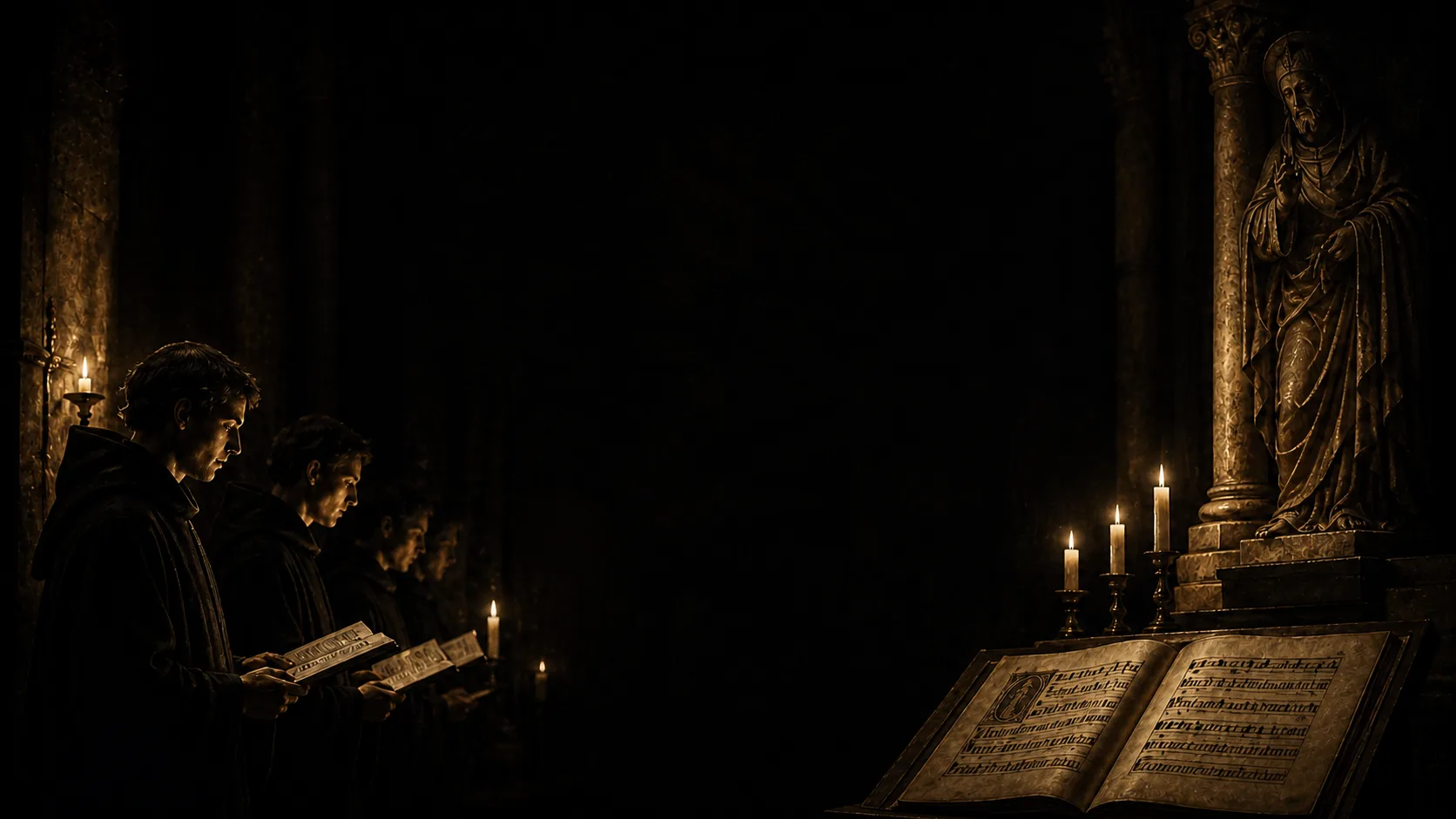
The majesty of the Transfiguration finds its perfect expression in Gregorian chant, where every interval and neume acts as a veil that both reveals and conceals the mystery.
The Introit Tibi dixit cor meum, composed in Mode III (Phrygian), evokes a mystical yearning. Its melodies, which once resonated in ancient stone cathedrals, create an atmosphere of ardent contemplation, where the soul earnestly seeks the face of God.
In some traditions, the Introit Illuxerunt fulgura tua is sung in Mode VII, an angelic and triumphant mode. The vocal frequencies here ascend with brilliance, imitating the divine lightning that illuminates the world and makes the earth tremble before the Creator’s majesty.
The Communion chant, Visionem quam vidistis, recalls Christ’s words commanding silence about the vision until the resurrection (Matthew 17:9). This chant invites monastic recollection, guiding the assembly into profound awe. Sacred acoustics make these melodies a tangible reflection of Tabor on the Eucharistic altar.
Join Our YouTube Community
Subscribe to our channel to listen to complete Gregorian chants, traditional prayers, and sung meditations.
Subscribe on YouTube 🔔