
The modern world often suffers beneath the weight of materialism, where the human soul exhausts itself seeking fleeting securities. Saint Lawrence invites us to profound interior transformation and absolute detachment.
His silent and burning testimony reveals that true joy resides not in possessing, but in giving oneself completely. Through his martyrdom, the Church of Rome found an imperishable light that illuminates the darkness of our own selfishness.
To contemplate the sacrifice of Saint Lawrence is to recover the capacity to love to the extreme, recognizing the suffering face of Christ in the most destitute.
Who was Saint Lawrence and why is he a martyr?
Saint Lawrence was one of the seven deacons of Rome under Pope Sixtus II, martyred in the year 258. He is venerated as a martyr because he gave his life on the gridiron for defending the goods of the Church and his faith in Christ.
As archdeacon, he administered temporal goods and cared for the marginalized of Rome. When Emperor Valerian unleashed persecution against Christians, he demanded the riches of the Church.
Saint Ambrose relates in his work De Officiis how Lawrence wept upon seeing Pope Sixtus led to martyrdom without him. The Pontiff prophesied that he would follow him three days later.
This wait was his supreme preparation for sacrifice. Instead of yielding to fear, his heart burned with the desire for the definitive encounter with the Lord.
The True Treasures of the Church
When Roman authorities demanded material wealth, Saint Lawrence asked for three days’ time. In that span, he gathered the blind, orphans, widows, the sick, and lepers.
Presenting this multitude to the prefect, he firmly declared: “These are the treasures of the Church.” This action was not a political provocation, but a profound theological confession.
Saint Augustine, in his sermons, highlights that Lawrence loved Christ in such a way that the exterior fire of martyrdom could not overcome the interior fire of his infinite charity.
What Gregorian chants accompany the liturgy of Saint Lawrence?
The Mass for the feast of Saint Lawrence is enriched with the Introit “Confessio et pulchritudo” and the Gradual “Dispersit, dedit pauperibus,” compositions that express the spiritual majesty of his sacrifice.
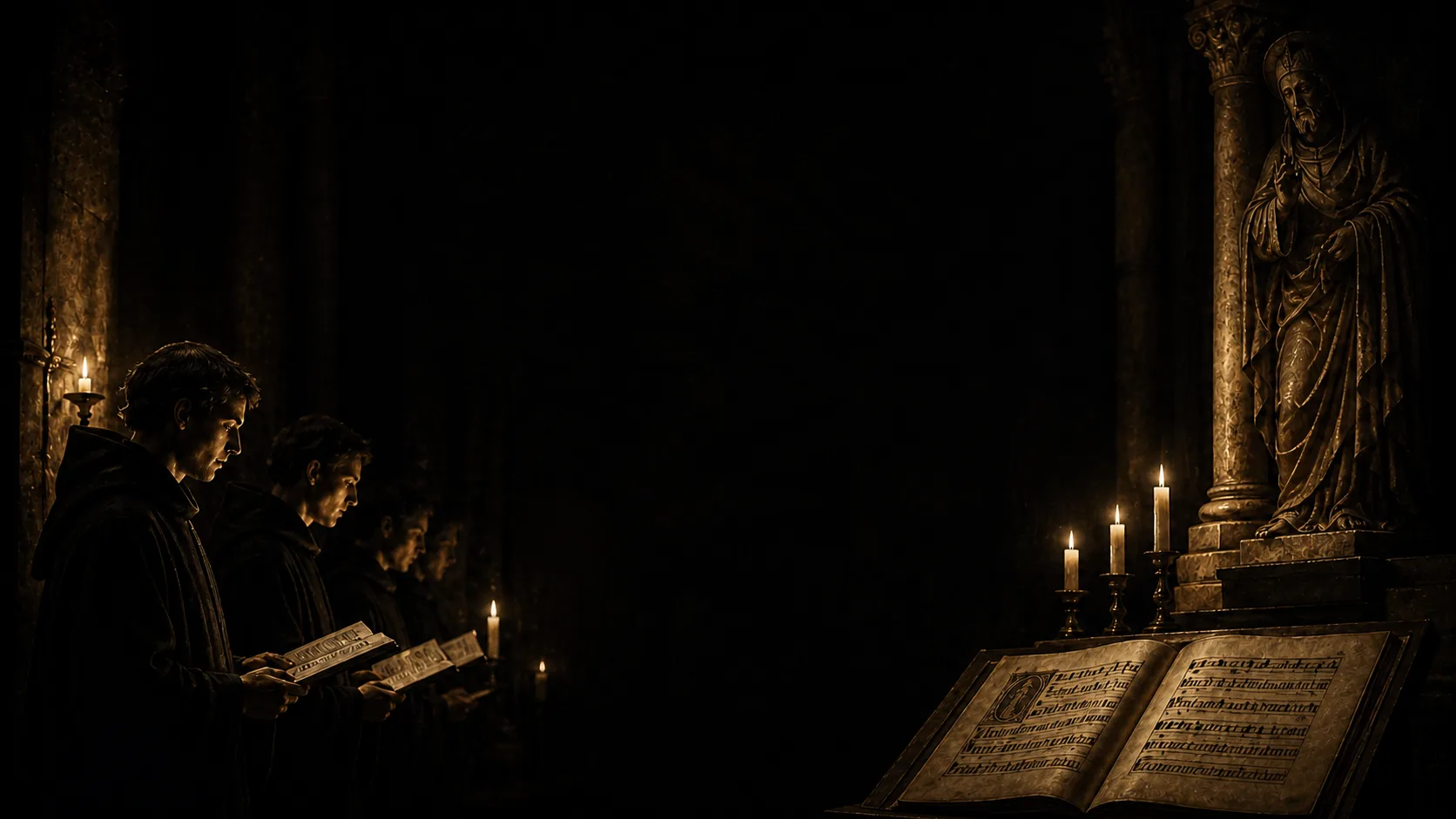
Liturgical chant envelopes the memory of the martyr with an austere and transcendent beauty. The stone vaults of the cathedrals resonate with the victory of grace over the pain of human death.
Through Gregorian chant, the praying Church participates in the deacon’s serenity amidst the flames. It is the voice of the soul that fully trusts in the promise of eternal life.
The Introit: Confessio et pulchritudo
The Introit Confessio et pulchritudo belongs to Mode III, a melodic mode known for its mystical, firm, and contemplative character. The melody rises with sobriety and absolute solemnity.
Its notes draw the glory that surrounds the martyr in heaven. The text reminds us that “praise and beauty are before Him; holiness and magnificence in His sanctuary.”
The frequencies of this mode invite the congregation to silence worldly noises and enter the ineffable mystery of the altar.
The Gradual: Dispersit, dedit pauperibus
The Gradual Dispersit, dedit pauperibus relies on Psalm 111 and is often sung in Mode VII, bright and angelic. It faithfully reflects the generosity of Lawrence, whose “hands distributed to the poor.”
The vocal intervals emphasize the word “pauperibus” (poor), reverently marking those whom the deacon loved and served. Monastic discipline in chant demands deep breathing and perfect intonation.
This chant is not a funeral lament, but a victorious testimony. In each neume resonates the echo of charity that conquers death itself and attains perpetual glory in the bosom of the Trinity.
Join Our YouTube Community
Subscribe to our channel to listen to complete Gregorian chants, traditional prayers, and sung meditations.
Subscribe on YouTube 🔔