
Saint Augustine of Hippo: The Restless Heart and the Mystery of Sacred Chant
The modern age suffers from profound anxiety and a constant search for authentic love. In this desert of noise and endless distractions, the timeless words of Saint Augustine resonate: “Thou hast made us for thyself, O Lord, and our heart is restless until it finds its rest in thee.”
Saint Augustine of Hippo was not only a brilliant theologian and philosopher but also a man of overwhelming passions who knew firsthand the anguish of a soul far from God. His radical conversion led him to understand the true nature of inner peace and eternal beauty.
At the center of this search for the transcendent, sacred music occupied a preeminent place in his thought. Augustine experienced the power of holy chant to elevate the spirit, console sorrow, and ignite filial devotion to the Creator.
What did Saint Augustine teach about music and chant?
Saint Augustine taught that music orders the soul toward divine truth, declaring that “singing belongs to one who loves” (Cantare amantis est). He emphasized that sacred chant must elevate the spirit to God, not serve as a mere aesthetic distraction.
In his famous treatise De Musica, Augustine presents a mathematical and spiritual conception of musical rhythms. True music is not simply a delight for earthly senses; it is a reflection of eternal order and a participation in celestial harmony.
The modulations of the voice in liturgical chant serve to soften the hardened heart. When the faithful sing psalms and hymns with devotion, grace penetrates more deeply, making revealed truth resonate in the innermost being of man.
The Confessions: The Beauty and Danger of Chant
In Book X, Chapter 33 of his Confessions, Augustine reveals a deep spiritual tension regarding liturgical music. He acknowledges the enormous utility of chant for awakening devotion, recalling how he wept abundantly upon hearing the hymns in the Church of Milan.
However, he warns of the danger that the pleasure of the melody might supplant the meaning of the sacred words. When the ear delights more in the voice than in the truth being sung, a fault is committed.
This Augustinian vigilance is the foundation of what would later crystallize into Gregorian chant: a purely vocal and spiritual music whose sole purpose is to clothe and serve the Word of God, without obscuring it.
Is it true that “he who sings well prays twice”?
The phrase “he who sings well prays twice” (Qui bene cantat bis orat) is traditionally attributed to Saint Augustine and summarizes his belief that chant performed with love and rectitude multiplies the intensity of prayer and the devotion of the heart.
Although the exact quote is not found literally in his preserved writings, it captures the essence of his teaching expounded in his commentary on Psalm 73. There he explains that the joyful song of praise (Jubilus) expresses what cannot be explained with words.
When the soul overflows with a love that exceeds human language, it takes refuge in wordless chant, in the abundant vocalizations of joy. This is the theological root of the long melismas of the Gregorian Alleluia on great feast days.
Sacred Chant: The Liturgy of the Feast
During the feast of Saint Augustine, the Church deploys liturgical texts that reflect his role as Doctor of Grace. The Introit of the Mass of Doctors, In medio Ecclesiae (Mode VI), presents a climate of gentle and serene wisdom.
The Introit begins by opening the treasures of divine Wisdom. Mode VI, known as Tritus plagalis, evokes humble devotion and loving contemplation, virtues that Augustine acquired after leaving his intellectual pride behind.
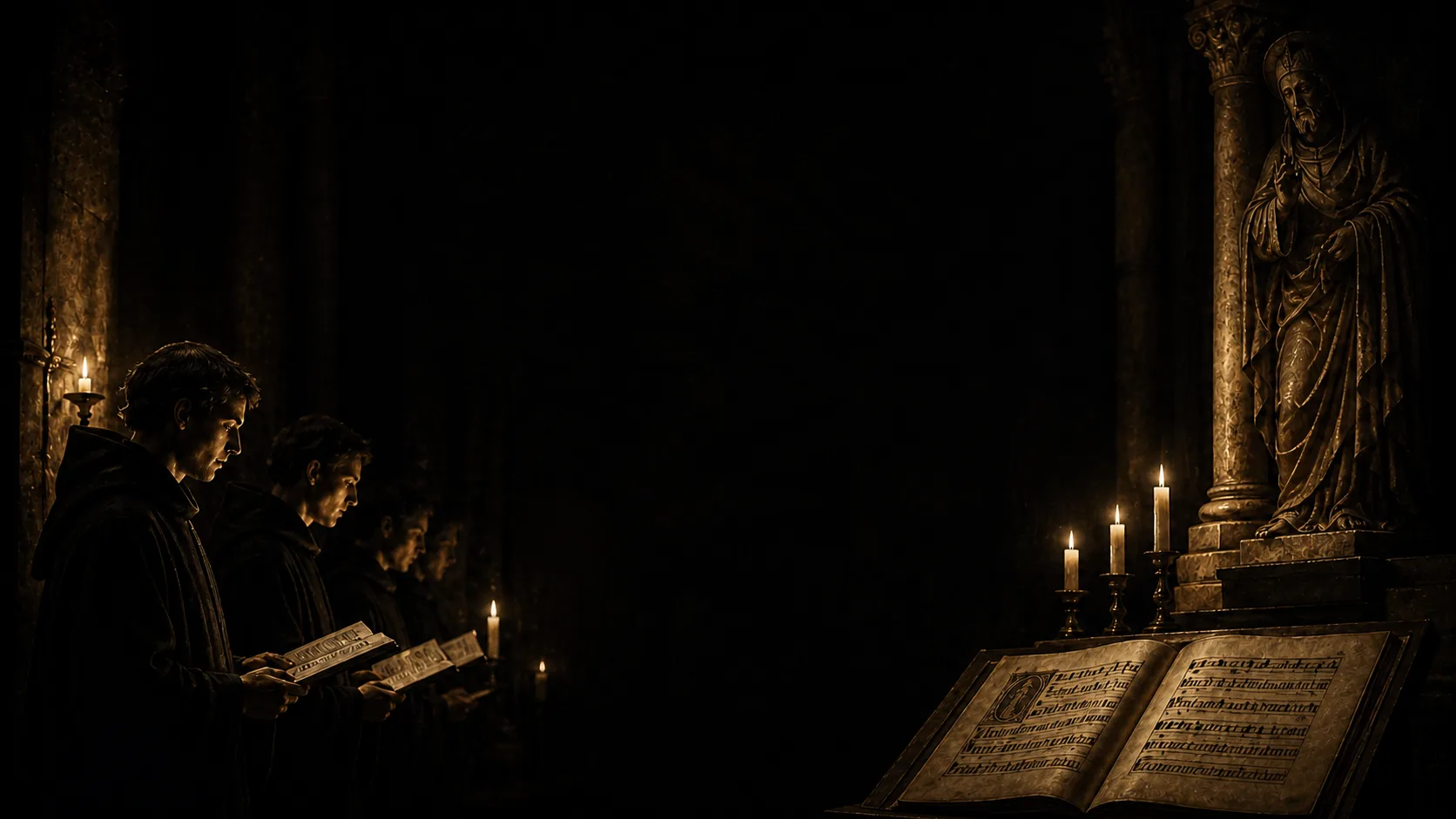
The acoustics of ancient stone basilicas amplified the vocal frequencies of the monks, creating a resonance that enveloped the faithful in an atmosphere of eternity. Thus, liturgical chant fulfills the Augustinian maxim: it is love that sings, and in singing, it rests in God.
Join Our YouTube Community
Subscribe to our channel to listen to complete Gregorian chants, traditional prayers, and sung meditations.
Subscribe on YouTube 🔔