
In the midst of the exhausting noise of modern life, Gregorian chant stands as an oasis for the spirit. Its ancient melodies do not only invite deep prayer, but act as a natural balm that relieves anxiety and restores rest to the weary body.
The Urgency of Silence in a Wounded World
We live in a state of constant alertness. Digital overstimulation and daily demands keep our minds in a tension that often translates into insomnia, fatigue, and an emptiness that is difficult to fill. For the Christian, this saturation is not just a physical problem, but an obstacle to the interior life. How can we hear the voice of God when the external noise never ceases?
Gregorian chant responds to this need by offering a sober beauty stripped of artifice. By focusing on a single melodic line without instruments, this chant deactivates the rush of thoughts and prepares the soul to meet the sacred.
The Rule of Saint Benedict: Silence as a Way to God
Silence is not the mere absence of words, but a disposition of the heart to listen to the divine presence. In Benedictine monastic life, stillness and liturgical chant form an indivisible unity that pacifies the spirit.
In chapter 52 of his famous Rule, Saint Benedict of Nursia writes about the oratory of the monastery: “The oratory should be what its name implies, and let nothing else be done there or kept there.” The Saint insisted on keeping the consecrated space free from any worldly noise so that, if anyone wished to pray privately, they could do so without interference.
Likewise, in chapter 19, dedicated to the discipline of singing the psalms, the patriarch of Western monks leaves us an everlasting spiritual key: “Let us sing in such a way that our mind may be in harmony with our voice” (ut mens nostra concordet voci nostrae). When the voice submits to the sacred text and the mind is stilled, the chant becomes the highest meditation, ordering internal chaos.
The Science Behind Sacred Sound: Cortisol and the Nervous System
Gregorian chant positively alters our physiology by lowering cortisol levels, the stress hormone. Its free melodic structure and harmonious intervals stabilize the heart rate and stimulate the parasympathetic nervous system.
Medical science has begun to validate what contemplative monks knew from spiritual experience. Studies in the neurobiology of sound reveal that monophonic chant, lacking a rigid or syncopated beat, does not generate expectations or tension in the brain. The breath synchronizes naturally with the phrasing of Ecclesiastical Latin, activating the vagus nerve and lowering blood pressure.
By decreasing cortisol production and increasing the release of endorphins, Gregorian chant induces a state of deep relaxation that facilitates the transition to restorative sleep. It is not mere acoustic entertainment; it is a therapy of order and peace for the body God has given us.
Prayer and Meditation: Beyond Superficial Relaxation
The contemporary world offers many meditation techniques that seek to empty the mind. Christian meditation, by contrast, seeks to fill it with the presence of God. Gregorian chant is not music for distraction, but for concentrating on what truly matters.
When we listen to chants like the In Manus Tuas (Into Your Hands, Lord) or the Salve Regina, we are not seeking a purely psychological calm. We are joining a centuries-old stream of faith. Every note is an act of abandonment to Divine Providence, a surrender of our daily burdens to the Heart of Christ.
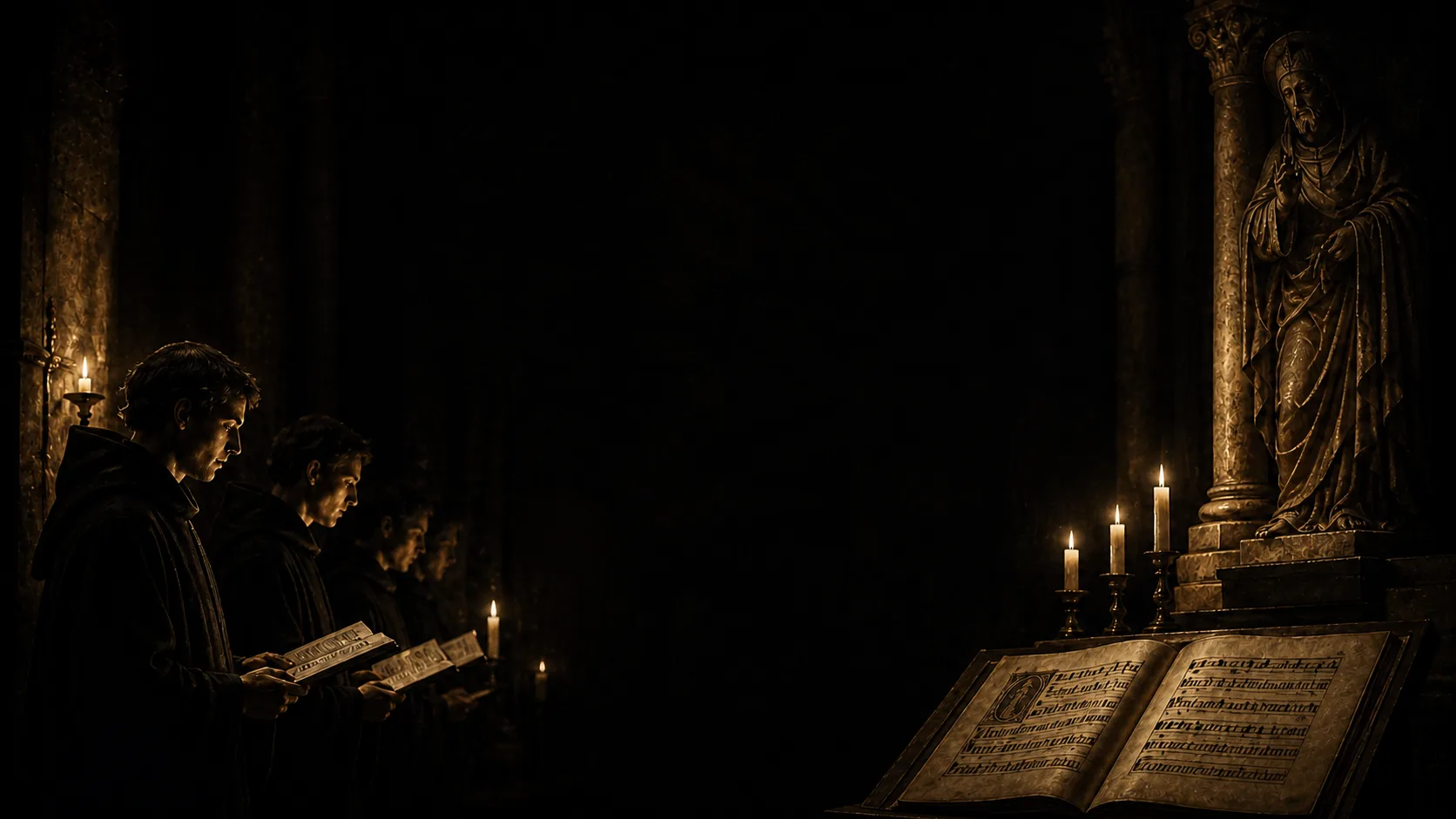
We invite you to pause, light a candle, and let these sacred melodies clear your mind before you go to sleep.
Frequently Asked Questions (FAQ)
How does Gregorian chant reduce anxiety?
Because it lacks a rigid meter, Gregorian chant allows the brain to rest from searching for rhythmic patterns. Breathing aligns naturally with the Latin phrases, lowering cortisol and activating the parasympathetic system that induces calm.
What does the Rule of Saint Benedict teach about singing?
Saint Benedict teaches that the mind of the one praying must fully agree with the liturgical voice (mens concordet voci). Singing should not be a display of personal virtuosity, but an act of humble obedience and surrender to the divine word.
Is it recommended to listen to Gregorian chant to fall asleep?
Yes. Scientific studies indicate that its monophonic, low-frequency tones encourage the emergence of alpha and theta brain waves, which are associated with deep relaxation and the initial stages of sleep, helping to combat insomnia.
Join Our YouTube Community
Subscribe to our channel to listen to complete Gregorian chants, traditional prayers, and sung meditations.
Subscribe on YouTube 🔔