
Every July 11th, the Church celebrates the feast of Saint Benedict of Nursia, patron of Europe and patriarch of Western monasticism. Beyond his immense spiritual and civilizing legacy, Saint Benedict structured the Divine Office, creating the temporal and liturgical framework where Gregorian Chant would be born, developed, and preserved.
Why is the feast of Saint Benedict celebrated on July 11th?
The feast of Saint Benedict is celebrated on July 11th to commemorate the translation of his holy relics from the ruined Abbey of Montecassino to the Abbey of Fleury (Saint-Benoît-sur-Loire, France) in the 7th century. Although his historical passing occurred on March 21, 547 AD, the Church moved the main celebration to this summer date to prevent it from always falling during the penitential season of Lent.
Pope Saint Gregory the Great, in Book II of his Dialogues, describes Benedict’s holy death with awe: having ordered his own grave to be opened six days prior, the saint entered the chapel at Montecassino supported by his monks and, after receiving the Holy Eucharist, breathed his last standing, with his hands raised in continuous prayer. It is this glorious transit and the subsequent expansion of his relics throughout the continent that cemented his title as Co-Patron of Europe, a continent rebuilt spiritually to the rhythm of his monasteries.
The Holy Rule: The Rhythm That Forged Sacred Chant
The Divine Office or Liturgy of the Hours, as we know it in the Western tradition, was definitively structured by the Rule of Saint Benedict. The distribution of the 150 Psalms of the Bible across the different hours of the monastic day established the order that gave birth to the entire Gregorian Chant repertoire.
Under the famous motto Ora et Labora (Pray and Work), the benedictine monk’s day was divided with absolute precision. Nothing was left to chance. The day and night were punctuated by eight hours of liturgical prayer, the Opus Dei (the Work of God), to which Saint Benedict ordered in his Rule that “nothing be preferred.” These canonical hours were:
- Vigils (or Office of Readings): Prayed in the darkness of the night, breaking the grand silence.
- Lauds: At dawn, celebrating the resurrection and light of Christ.
- Prime, Terce, Sext, and None: Small daytime prayers to sanctify daily manual labor.
- Vespers: At evening, giving thanks for the blessings of the day.
- Compline: The last prayer of the day, before the night rest and the start of absolute silence.
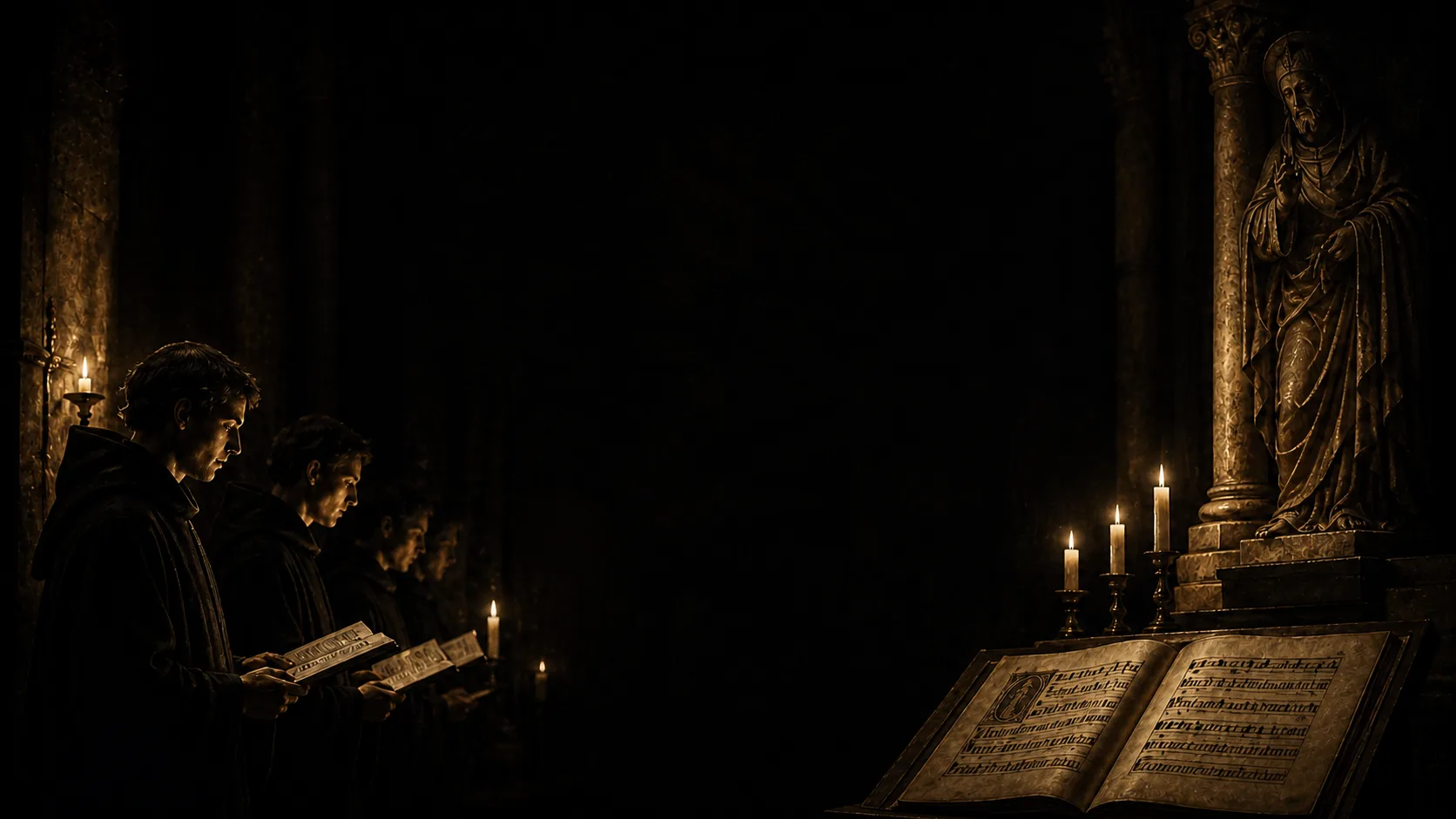
This uninterrupted cycle forced the monks to gather in the monastery choir eight times a day to chant from memory and in community the texts of the Sacred Scripture. Without this daily rhythm of monastic chanting, European sacred music would never have developed its melodic structure or its theological depth.
”Mens Concordet Voci”: The Theology of the Chanting Voice
Saint Benedict established a fundamental theological principle for liturgical chanting in Chapter 19 of his Rule: «Mens concordet voci» (let the mind agree with the voice). This postulate requires that Gregorian chant be a prayer born from the heart, where the intellect and spirit humbly submit to the words of the Psalms.
For Saint Benedict, music in church is not a secular ornament or a display of vocal virtuosity, but a heavenly liturgy lived on earth. The Gregorian melody, devoid of rigid time signatures and instrumentation, flows in a free and floating manner precisely to reflect the eternal order of God.
In our productions at Kairós Studio, we seek to honor this Benedictine legacy. When recording sacred chant in ecclesiastical Latin, we use spatial reverbs that emulate the natural acoustics of great stone cathedrals and ancient churches. This empty space and its resonance are not just technical tools, but the physical translation of monastic silence and the immensity of the divine mystery that Saint Benedict so deeply defended.
How to live the spirit of Saint Benedict today?
To apply Saint Benedict’s spirituality in modern life, one does not need to retreat to a monastery; it is enough to incorporate sacred moments of silence, sanctify daily work by offering it to God, and dedicate brief pauses of prayer to break the noise of daily routine.
Ultimately, the feast of July 11th is an invitation to restore order to our souls. In an overstimulated and anxious world, Benedictine Gregorian chant and contemplative pauses offer us a sanctuary where the mind can fall silent to listen to the voice of the Creator.
Explore the Sacred Library
Continue discovering the lives of the saints, traditional prayers, and Gregorian chants to deepen your faith.
Keep Discovering 📖