
What is the meaning of the Assumption of the Virgin Mary?
The Assumption of the Virgin Mary is the mystery by which the Mother of God, having completed the course of her earthly life, was assumed body and soul into heavenly glory. It is the promise of our own resurrection and the definitive triumph over the corruption of death.
In a modern world burdened by the fear of mortality and the decay of the flesh, this feast shines as an unshakeable hope. The Church teaches that the body which bore the Author of Life could not endure the corruption of the grave. The Assumption is not merely an isolated privilege, but the anticipation of the destiny to which every redeemed human soul is called.
The mystical silence of Mary’s passing invites us to contemplate life not as a descent into nothingness, but as a sacred pilgrimage toward eternity. In the profound rest of the Virgin, we find the perfect repose in the arms of the Creator. It is a powerful reminder that our mortal frame is ultimately destined for physical glorification.
The liturgy of this day breathes an air of serene victory. There is no mourning in this departure, but rather the exultation of a perfect creature entering the eternal embrace of the Holy Trinity. The heavens open wide to receive their Queen, crowned with stars and radiant in grace.
Why is the Assumption a dogma of the Catholic Church?
The Assumption was declared an infallible dogma to affirm and protect the Church’s ancient faith in the bodily glorification of Mary, sealing centuries of unanimous devotion and reaffirming the dignity of the human body in the plan of salvation.
On November 1, 1950, the venerable Pope Pius XII pronounced the solemn words in his apostolic constitution Munificentissimus Deus, confirming the unwavering faith of the Christian people. The Pontiff declared under the light of the Holy Spirit the truth that the faithful had already guarded in their hearts for generations.
In his dogmatic definition, Pius XII proclaimed in Latin: “Immaculatam Deiparam semper Virginem Mariam, expleto terrestris vitae cursu, fuisse corpore et anima ad caelestem gloriam assumptam”. This sentence emphasizes that the Immaculate Mother did not experience earthly dissolution, but an immediate elevation to divine glory.
The dogma answers the profound spiritual instinct of catholicity. The ancient Eastern liturgies long celebrated the Dormition as the serene passage to true life. Mary’s bodily assumption confirms that human flesh, sanctified by grace, holds a reserved place in the very heart of heaven.
Gregorian Chant in the Liturgy of the Assumption
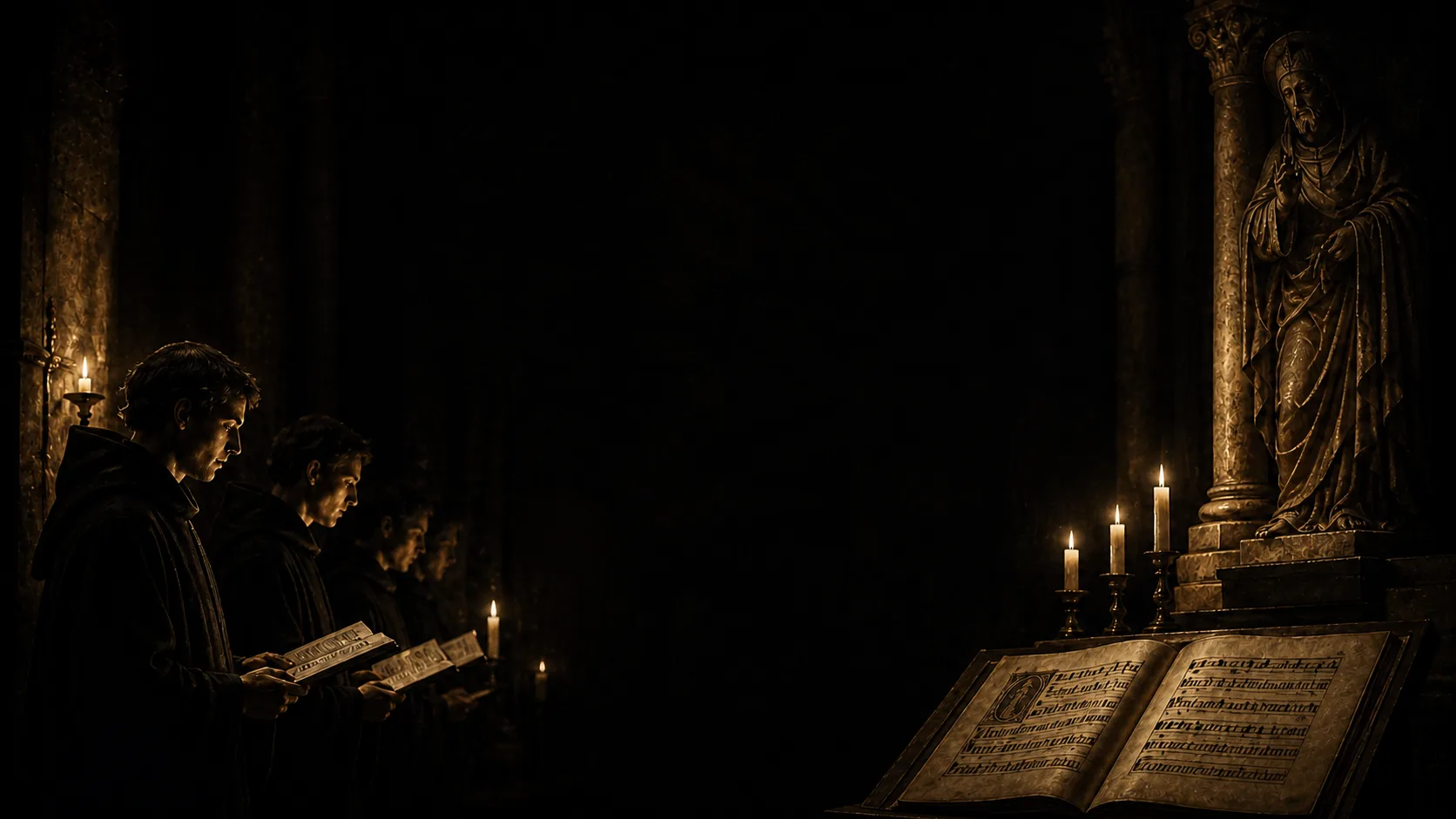
The majesty of this solemnity finds its purest expression in Gregorian chant, where ancient monastic melodies translate spiritual elevation into pure sound. The music of the Assumption is a reflection of celestial architecture, echoing with acoustic perfection under high stone vaults.
The Mass Introit, Signum magnum apparuit in caelo (Revelation 12:1), unfolds in Mode VII (Mixolydian). This mode is traditionally known as the bearer of a brilliant and triumphal sonority that perfectly represents celestial glory. The ascending intervals of this piece lift the human soul, musically illustrating the Woman clothed with the sun.
In profound contrast and theological complementarity, the Communion Antiphon Beatam me dicent (Luke 1:48) utilizes Mode VI (Hypolydian). This mode, sweet and deeply contemplative, reflects the thanksgiving and perfect humility of the Virgin. The melody descends gently upon the faithful soul, offering eternal comfort and peace.
Join Our YouTube Community
Subscribe to our channel to listen to complete Gregorian chants, traditional prayers, and sung meditations.
Subscribe on YouTube 🔔